
Attention, The New Currency
How Modern App Design Patterns Affect the Sustained Focus of College Students
Abstract
College students spend on average 4+ hours daily on social media and entertainment apps—platforms engineered around principles of behavioral psychology to maximize sustained engagement. This study investigates whether modern app design patterns, particularly variable ratio reinforcement mechanisms such as infinite scroll and push notifications negatively affect the ability of college students to maintain sustained focus during studying sessions. A short survey was distributed to CCNY classmates and AI/Machine Learning undergraduate fellows (n = 6), measuring self-reported daily screen time, focus duration before checking device, phone proximity during study sessions, perceived changes in attention span, and most used applications. All six respondents reported keeping their phone nearby while studying; the majority reported feeling the urge to check their phone within 25 minutes or less. Five out of six respondents noted a perceived decline in their attention span over recent years. These findings, though limited in sample size, align with existing literature on variable reward design and attention fragmentation, and suggest that app design poses a meaningful barrier to academic concentration for student populations.
Introduction
The average college student spends upwards of 4 hours daily on their smartphone, a trend that researchers and designers alike have begun to scrutinize more closely. Modern social media applications are engineered around psychology, most notably operant conditioning and variable ratio reinforcement—a reward mechanism in which unpredictable payoffs such as notifications, likes, or recommended content produce repeated engagement behavior. Internal research, including data leaked from Meta acknowledging links between Instagram use and user wellbeing, suggests that these patterns are understood at the corporate level and continuously refined. Design choices such as haptic feedback during “pull to refresh” gestures, infinite scroll, high saturation color schemes, just to name a few, all work in concert to sustain user attention. Some researchers have described this process as “human fracking”—the systematic extraction of attention as a resource—a framework that situates app design within a broader conversation about attention economics and user autonomy (Williams 1).
While existing literature address the public health angle of these design patterns, little research focuses on students as a distinct population, one whose academic performance depends heavily on the capacity for sustained, deep focus. This study examines how modern app design patterns affect the ability of students to concentrate for extended periods, with particular attention to STEM students. In investigation, this study employs two methods: a survey administered to STEM undergrads to gather firsthand data on screen habits and self-reported focus, and a secondary analysis of peer- reviewed literature and published data that document the behavioral and neurological effects of variable reward design. These approaches are used in combination to connect broader design trends to the lived academic experience of students.
Materials and Methods
This study used 2 approaches, combining a primary survey with secondary literature analysis. A 5 question Google Form survey was distributed to CCNY classmates enrolled in ENGL 210 during the Summer 2026 session and a Lab section of Break Through Tech’s AI/ML 2026-2027 Cohort. The survey collected responses on: (1) average daily hours spent on social media and entertainment applications, (2) estimated focus duration before feeling the urge to check one’s phone while studying, (3) whether the phone is kept nearby during study sessions, (4) self-reported perception of changes in attention span over the past several years, and (5) most frequently used applications. Six responses were collected over a 48 hour window (June 20–22, 2026). Responses are anonymous and participation was voluntary.
In parallel, secondary sources were consulted to contextualize survey results within the broader research landscape. These included peer-reviewed studies on variable ratio reinforcement and smartphone use and academic frameworks on attention economics. The combination of primary self-report data and secondary literature allows for a richer interpretation of results than either method alone would provide.
Results
All six respondents (100%) reported keeping their phone nearby while studying. The majority spent between three and four hours daily on social media or entertainment apps (Fig. 1), with two respondents reporting five or more hours of daily use.
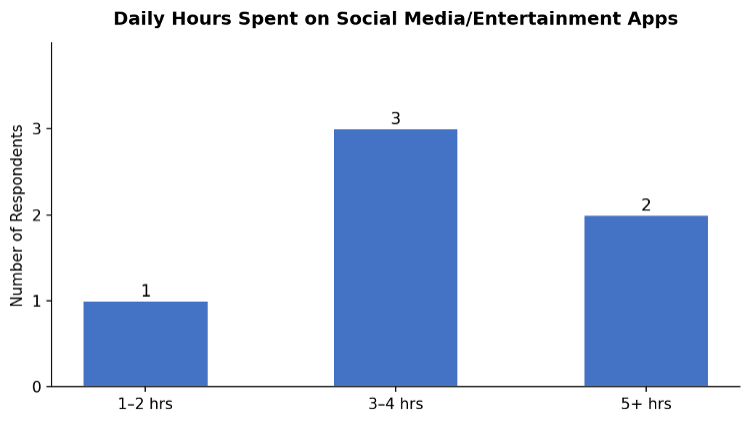
Fig. 1. Self-reported daily hours spent on social media and entertainment apps (n = 6)
When asked how long they could study before feeling the urge to check their phone, the majority of respondents reported a threshold of 25 minutes or less: two respondents reported checking within 5 minutes, two within 25 minutes, one within an hour, and one respondent reported never feeling the urge to check (Fig. 2). This suggests that for five out of six respondents, sustained focus is interrupted within ~60 minute study window.
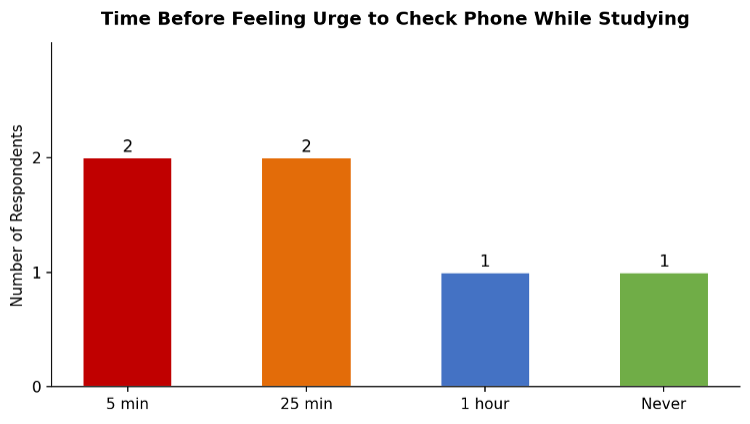
Fig. 2. Estimated focus duration before feeling the urge to check one’s phone while studying (n = 6)
TikTok was the most frequently used application among respondents (50%), followed by Instagram (33.3%) and YouTube (16.7%) (Fig. 3). Notably, the two most used platforms —TikTok and Instagram—are both designed around short form, algorithmically curated content feeds with infinite scroll features.
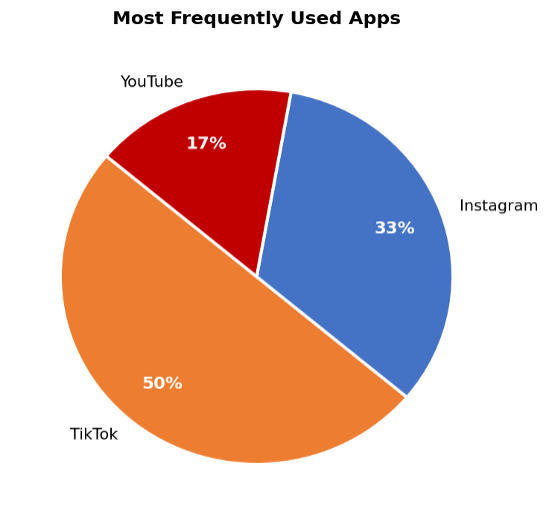
Fig. 3. Distribution of most frequently used applications among survey respondents (n = 6)
Five of the six respondents reported a perceived decline in attention span over recent years. Qualitative responses were notably candid. One respondent wrote: “My attention span has definitely reduced over the years. I find myself less and less focused, and I struggle to complete activities I used to enjoy as a child, like reading.” Another noted: “I noticed my focus span being reduced due to constant notifications, keeping me looping back to my device every now and then.” Only one respondent reported an improvement, attributing it to increased academic pressure. Table 1 summarizes the quantitative results across all survey questions.
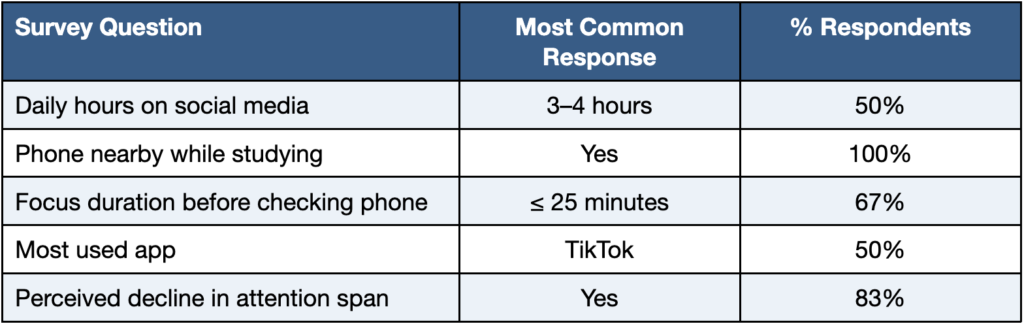
Table 1. Summary of survey responses (n = 6)
Discussion
The results broadly support the study’s hypothesis: modern app design patterns appear to negatively affect the sustained focus of college students. The finding that 100% of respondents keep their phone nearby while studying is particularly significant. Research on attention residue—the cognitive cost of an unfinished task pulling on working memory—suggests that mere phone proximity, even without active use, reduces available cognitive capacity (Leroy 168). Just the presence of a smartphone on a desk has been shown in controlled studies to impair fluid intelligence and working memory (Ward et al. 140).
The focus duration data further supports this interpretation. With 67% of respondents reporting an urge to check their phone within 25 minutes, the data suggests that for most students, even a standard 50 minute class period exceeds their comfortable attention window before being disrupted by a notification. This is consistent with research documenting average smartphone check frequencies of once every 12 minutes among young adults (Rosen et al. 2501). The dominance of TikTok and Instagram, platforms that deliberately deploy variable reward scheduling through algorithmically unpredictable content feeds, adds behavioral specificity to this pattern.
The qualitative responses are the most evocative dimension of the data. The respondent who described once reading six 500 page books in a week as a child and now struggling to finish half of one encapsulates the experiential dimension that aggregate statistics alone cannot capture. This anecdotal evidence resonates with neurological research suggesting that habitual short form content consumption may progressively recalibrate dopamine reward thresholds, making sustained engagement with slower reward activities—like reading or studying—feel disproportionately effortful (Alter 5).
Limitations
This study has several limitations. The sample size of six respondents is too small to support statistically generalizable conclusions; the results are exploratory and directional rather than definitive. The sample was drawn from only two course sections, which may not represent the broader undergraduate population. Additionally, the study relies entirely on self-reported data, which is susceptible to recall bias and social desirability effects (slightly mitigated by the anonymity clause). Future research should deploy larger randomized samples, incorporate objective screen time data (available via iOS Screen Time and Android Digital Wellbeing APIs), and design controlled experiments to isolate the effect of specific design features—such as push notification frequency or content feed algorithm type—on measurable cognitive performance metrics.
Conclusion
This study contributes a student centered perspective to an ongoing conversation about app design and cognitive wellbeing. The survey data, though modest in scope, consistently points toward a pattern in which high daily social media use, phone proximity during studying, and short focus windows coexist among college students. These findings have implications both for how students approach their study environments and for how institutions might address digital distraction as an academic equity issue. As attention becomes an increasingly engineered and extracted resource, understanding its dynamics within student populations is not merely academic…it is urgent.
References
Alter, Adam. Irresistible: The Rise of Addictive Technology and the Business of KeepingUs Hooked. Penguin Press, 2017.
Leroy, Sophie. “Why Is It So Hard to Do My Work? The Challenge of Attention Residue When Switching Between Work Tasks.” Organizational Behavior and Human Decision Processes, vol. 109, no. 2, 2009, pp. 168–181.
Rosen, Larry D., et al. “The Media and Technology Usage and Attitudes Scale: An Empirical Investigation.” Computers in Human Behavior, vol. 29, no. 6, 2016, pp. 2501– 2511.
Ward, Adrian F., et al. “Brain Drain: The Mere Presence of One’s Own Smartphone Reduces Available Cognitive Capacity.” Journal of the Association for Consumer Research, vol. 2, no. 2, 2017, pp. 140–154.
Williams, James. Stand Out of Our Light: Freedom and Resistance in the Attention Economy. Cambridge University Press, 2021.
Troianovski, Anton, and Deepa Seetharaman. “Facebook Knows Instagram Is Toxic for Teen Girls, Company Documents Show.” The Wall Street Journal, 14 Sept. 2021.
AI Use Disclosure
I used Opus 4.8 to compile research and to assist with the structure of this assignment. I reviewed all AI generated content for accuracy and take full responsibility for the final work.

