
Turning Focus into Results: SOAR
An Open-source Initiative for CUNY Student Performance
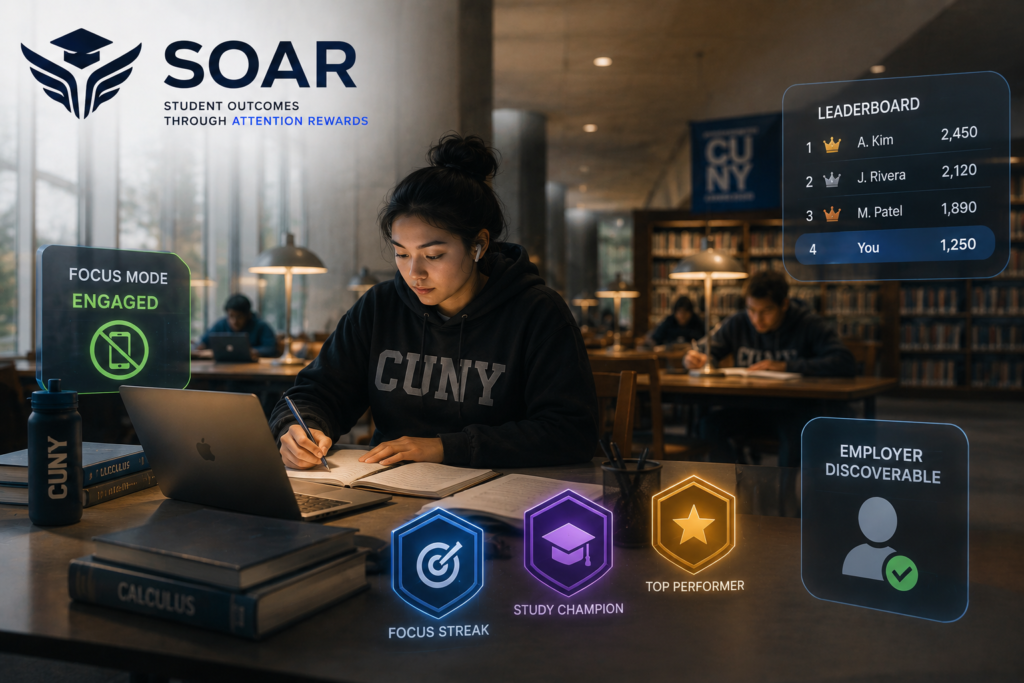
Intro
College students across New York City are losing the ability to focus, a direct result of modern app design on smartphones. As shown in my lab report “Attention, The New Currency,” social platforms are engineered variable ratio reinforcement, essentially slot machines in our pockets, to keep users scrolling.
Survey data from STEM students found that 100% kept their phone nearby while studying, and most felt the urge to check it within 25 minutes. This is not a problem unique to any single campus—it is a citywide condition affecting roughly 225,000 students enrolled across CUNY’s 25 colleges.
Yes, existing tools like Apple’s Screen Time, Android’s Digital Wellbeing, and an app called Freedom (multiplatform), all attempt to address this by blocking distracting content, but rely on willpower alone and offer little to no incentive to keep using them.
This proposal outlines a student account feature, tied to a verified account, that adds a social and reward layer to existing distraction blocking software—piloted first as an open-source initiative within CUNY, a proof of concept, before being considered for system wide adoption.
Background
Time tracking / distraction blocking apps are not a new thing and so what’s making them not attractive to use? Freedom, created by Fred Stutzman to help him finish his PhD dissertation, works well in that it’s a multiplatform solution and effectively blocks distracting websites and apps.
Although it’s a great innovation, the problem is retention, the incentive to keep using the platform. Once the novelty wears off, students have little reason to keep enforcing limits on themselves. This matters more for students than for general users, since sustained focus is literally a direct proxy to academic performance.
Research backs this up… blocking mobile internet access has been shown to improve sustained attention and subjective wellbeing (Castelo et al. 3). Additionally, workplace studies have found that a reduction in digital distractions measurably increases productivity and focus (Mark et al. 933).
My lab report’s survey data reinforces the need for something like this, where ~80% of respondents reported a perceived decline in attention span, tiktok and instagram being the most used (De Leon 5). What’s missing from current tools is a reason to stay engaged with them, essentially fighting fire with fire.
A student account feature that turns focused time into a tangible benefit (through leaderboards, badges, eligibility for internships and scholarships) could close this gap and because CUNY is both a single governing body and a network of 25 distinct campuses, it offers a rare testing ground—Small enough to pilot quickly at one college, large enough that a successful pilot could plausibly scale citywide without needing a different institution’s buy in.
Proposal Statement
SOAR (Student Outcomes through Attention Rewards) is my proposed solution to solving this attention problem prevalent among NYC’s undergad student base. It essentially is a verification and reward layer built on top of existing distraction blocking software, beginning as an open-source pilot at a single campus and scaling to additional CUNY colleges based on measured success.
Concretely, this means building a lightweight authentication and points system that connects to the Freedom API, launching it first to a volunteer cohort of students at let’s say, City College, and tracking focused hours data against app-reported attention and academic outcomes over one to two semesters.
If the pilot shows a measurable increase in sustained focus or engagement with blocking software compared to a control group not using SOAR, the proposal calls for CUNY’s central administration to formally adopt and fund the expansion of the system across its other colleges. From here an employer portal eligibility layer (internship/scholarship visibility) becomes viable, since it requires a verified system-wide student population to be meaningful to external companies.
It’s important to highlight that this proposal does not assume that all of CUNY is guaranteed to adopt or even likely to succeed on the first attempt. It asks only for the resources to test the idea responsibly and at a small scale, before asking for institutional commitment.
Technical Description
Let’s break it down. SOAR in simple terms, is a verification and reward layer that sits on top of existing distraction blocking software, turning every hour a student spends phone free into a point that counts toward social recognition and employer visibility.
Rather than building new blocking technology, SOAR plugs into the API of an established platform like Freedom, authenticates the user as a verified student (.edu email), and routes their focused time data into a CUNY-wide leaderboard and badge system. In short, existing apps already measure focus, SOAR is what makes that focus worth something.
The system breaks down into three parts:
Authentication confirms that a user is an enrolled student by requiring sign in through their CUNY email. This is a strict gatekeeping layer (no CUNY account, no points).
Points system ingests focused, distraction free hours as reported by the connected blocking app’s API and converts them into a running point total per student.
Leaderboard displays accumulated points, both individually and ranked against peers, and awards digital badges at point thresholds which is a high signal, visible incentive layer that gives students a reason to keep their blocking app turned on.
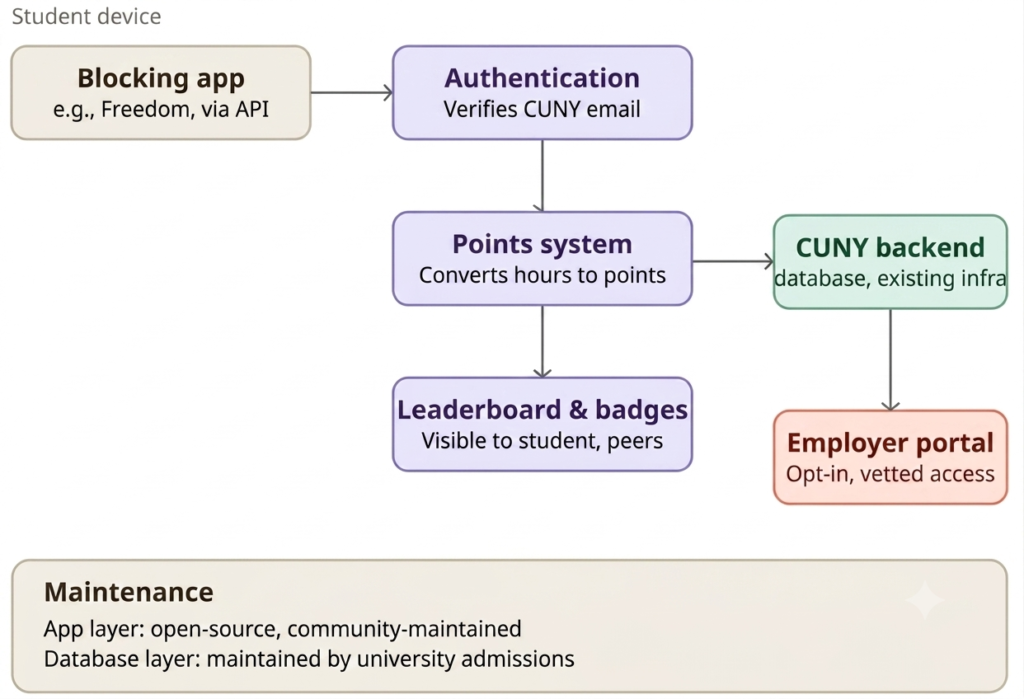
Data moves in one direction. Students Freedom app reports focused hours, SOAR authenticates and converts those hours into points, the CUNY’s existing database stores the record, and* (only with the student opting in) an employer facing portal can view eligibility status for internships / new grad roles. What’s even better is that no new physical infrastructure is required for any of this to run. CUNY’s current systems hold the data, and administration would maintain that layer going forward.
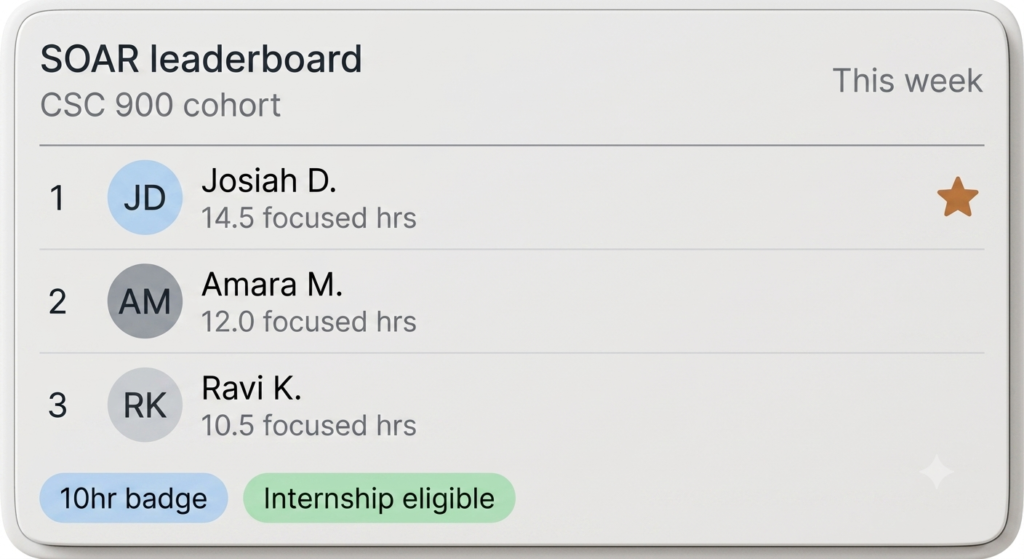
SOAR’s only input is distraction free time, already tracked by Freedom. Its outputs are digital badges and standing on the leaderboard and*, for students who opt in after the initial phase, eligibility signals visible to participating employers, framed as priority consideration rather than a guarantee.
User interaction happens through mobile or web app versions of the Freedom application. No separate device or hardware are required.
Maintenance is split deliberately to limit institutional cost as universities already have a lot to deal with. The app itself will be maintained as an open source project (like a capstone or even club initiative), while the database connecting it to CUNY records falls under existing administrative infrastructure rather than a new department. It’s as simple as creating a new table in an SQL database.
Cost, Materials, Labor, and Time
With regards to materials needed for the project, SOAR requires no new physical hardware. For the open-source pilot phase, the required infrastructure is as follows:
- A small cloud server
- A domain name
- An SSL certificate
- A nonprofit certificate authority
Freedom (the app) itself is a paid consumer product, currently priced at $39.99/year per user for its premium tier, which includes the cross-platform blocking feature this depends on. Rather than asking each pilot student to cover this individually, a realistic version of this proposal would either; a) negotiate a bulk educational license with Freedom or, b) more conservatively, restrict the pilot to students who already subscribe. This keeps CUNY’s direct cost at $0 for this component in Phase 1.
This is what one semester for the pilot phase could look like in terms of cost
- Cloud hosting: ~$25-30 (3-4 months at $5-10/month, scaling with a small user base)
- Domain registration: ~$12-15
- SSL certificate: $0 (via Let’s Encrypt)
- Freedom licensing: $0 in Phase 1 (existing subscribers only) or ~$40/student/year if CUNY chooses to subsidize
Estimated total at scale is under $50 for infrastructure alone, or roughly $2,000 to$4,000 if CUNY opts to subsidize Freedom licenses for a 50 to 100 student pilot cohort
In terms of a viable timeline, it would take one semester to build, one to two semesters to collect pilot data, followed by an evaluation period before any CUNY wide funding decision. So give or take roughly, 1 year to launch.
Results and Significance
If successful, SOAR’s results would be immediately measurable. The direct metrics of it’s success: an increase in sustained attention AND distraction free study time among participating students. The positive outcomes of these metrics are backed by Castelo’s findings on blocking mobile internet access improving sustained attention and, by the industry case study findings, authored by Mark and others, that reduced digital distraction increases productivity.
A successful pilot would not only give deserving students the chance to directly connect with prominent employers, the end goal of getting a degree in the first place, but it also lets CUNY measure and gather data on another angle of student success which can be used later to create future programs or improve existing ones.
The broader significance is specific to CUNY’s role in New York City. CUNY serves a uniquely
large population of first generation, working, and lower income students, for whom academic performance is often most directly tied to future economic mobility. A system that turns improved focus into real and visible advantages—leaderboard recognition, badges, and of course, eventually an employer portal—gives CUNY a tool that other private universities, with smaller or wealthier student bodies, have less institutional incentive to build. If SOAR works at the “metro scale”, it could plausibly be offered as a model to other public university systems facing similar attention and retention challenges, not just within New York City but nationally.
Conclusion
This initiative does not propose to solve student distraction outright. No single tool in the real life backed by millions and trillions of dollars can fully counter applications explicitly engineered to capture attention. What it proposes is more modest and, I’d argue, more honest: giving students a reason to keep using tools that already work, by connecting focus to outcomes they actually care about.
Whether that’s enough to meaningfully shift behavior at scale is an open question, and is one this proposal intentionally answers by piloting rather than assuming. If CUNY can prove this model works for a few thousand students at one campus, the harder and more interesting question becomes what would it mean to offer the same advantage to the rest of New York City’s public school system?—and, beyond that, to public universities nationwide asking this same question.
Works Cited
Brownridge, John, et al. “The Digital Workplace Productivity+ Series: Part 1.” Capital H Blog, Deloitte, 31 Oct. 2024
Castelo, Noah, et al. “Blocking Mobile Internet on Smartphones Improves Sustained Attention, Mental Health, and Subjective Well-Being.” PNAS Nexus, vol. 4, no. 2, Feb. 2025
De Leon, Josiah. “Attention, The New Currency: How Modern App Design Patterns Affect the Sustained Focus of College Students. ” ENGL 210, City College of New York, June. 2026, Unpublished manuscript
Mark, Gloria, Shamsi Iqbal, and Mary Czerwinski. “How Blocking Distractions Affects Workplace Focus and Productivity.” UBICOMP/ISWC ‘17 Adjunct Proceedings, ACM, Sept. 2017
AI Use Disclosure
I used Google Gemini to generate images including the first image. Opus 4.8 was used to generate user UI diagrams. I reviewed all AI generated content for accuracy and take full responsibility for the final work.

